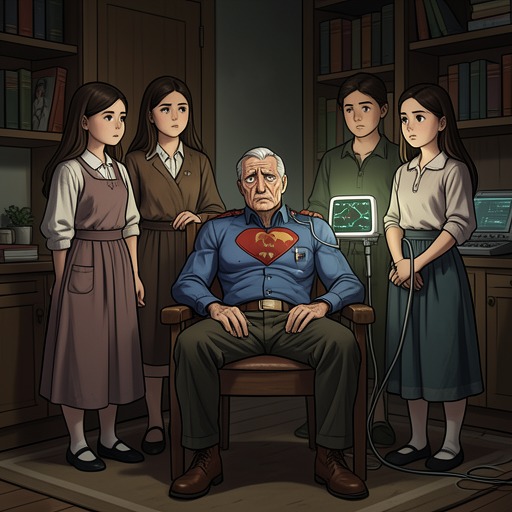
Jada’s Father Suffers a Heart Attack
The ExceptionJada’s father’s heart attack turns an ordinary change of plans into an urgent return to family, and makes the hospital room the setting for his clearest reflection on how he has spent his life. The episode brings Jada and Kari together at his bedside, confronts them with their father’s vulnerability, and gives his recovery a significance beyond the medical outcome: his warning is to choose happiness before time runs out.
The Call and Sudden Return
Jada learns of the emergency while away from home. Heather hands her a phone whose screen indicates that Max is calling, but Kari’s voice comes through, breaking as she tells Jada that their father has been admitted to the hospital. Kari explains that he is at Mary Sherman Hospital, where she works, and that a friend on the staff recognized him and contacted her. The staff suspect he has had a heart attack, though Kari stresses that she does not yet know what has happened.
Kari and her traveling companions have just landed at Sky Harbor and are on their way. Jada immediately says she needs to be there. Their departure had been planned for several days later, but the possibility that her father is seriously ill makes that schedule feel irrelevant. The call changes the priority of the day: uncertainty about his condition is enough to send Jada back at once, even before the family has a confirmed diagnosis.
At Their Father’s Bedside
When Jada and Kari enter their father’s room, they do so quietly. He is asleep with an oxygen tube in his nose and monitors attached to his chest. The equipment makes the seriousness of his condition visible to his daughters, and Jada instinctively takes Kari’s hand. Their shared gesture gives the scene a familial focus: neither sister faces the sight alone.
Their father wakes when the blood-pressure cuff makes a sound. He initially mutters about the device, then notices his daughters and greets them warmly, trying to move before his condition stops him. The contrast between his limited physical strength and his evident pleasure at seeing them shapes the encounter. Jada says she is doing well, but the sound of her own voice makes clear that she does not quite believe it. The emergency has unsettled her even as she tries to reassure him.
What He Tells His Daughters
Taking Jada’s hand, their father urges both daughters to be happy while they can. He speaks from the immediate knowledge that a person can be taken sooner than expected, and asks them to consider what truly matters when life is suddenly uncertain. His message is not an abstract lesson offered from a distance: he is speaking from a hospital bed, after an event that has made his vulnerability impossible to ignore.
He connects that advice to specific regrets. He wishes he could go back and redo parts of his life, including the hours he spent at the office, the times he let his wife go to bed angry rather than apologize, and his irritation at the doll shoes his daughters left around the house when they were young. He describes these not as isolated dramatic failures but as energy wasted on work and minor resentments. The memories link his daughters’ childhood, his marriage, and his working life in one account of priorities repeatedly misplaced.
Kari squeezes Jada’s hand as Jada struggles to contain her emotions. Their father’s recollections therefore reach the sisters not only as advice but as a family history being reconsidered aloud. His examples are ordinary and particular: hours at work, an apology withheld, toys scattered at home. Against the possibility of losing him, each takes on a different weight. The episode does not establish that his daughters immediately change their lives; it does show why his appeal to choose happiness has force for them in that room.
Diagnosis and Aftermath
The later medical explanation confirms that their father has had a heart attack, but the permanent damage is minor. The doctors plan to keep him overnight for monitoring while they await one final test result. Better diet, exercise, and stress-management plans are recommended, and the prognosis is that he should be fine. The outcome turns the initial fear toward cautious relief without erasing the seriousness of the event: he still needs observation and changes to his routine.
The day remains emotionally draining for Jada. She thinks of the families in the waiting room who are crying and worrying, and wonders how Kari manages to work in that environment every day. Cane’s hourly texts are among the few bright spots she identifies. As Jada leaves, Cane follows her to the freeway before their routes diverge. The episode thus closes not with a claim that the crisis has been forgotten, but with medical reassurance, family concern, and the support Jada receives while carrying the day’s strain.
Significance
The heart attack gives the book’s recurring concern with happiness a concrete family setting. Their father’s warning is sharpened by the difference between what can be changed and what cannot: he can name the work, anger, and small irritations he wishes he had handled differently, but he cannot return to the years when those choices were being made. His daughters hear that reflection while he is still alive to share it, and while the diagnosis leaves room for recovery.
For Jada, the event also arrives amid a life marked by difficult decisions about what she will accept in intimate relationships. The hospital scene does not resolve those decisions for her, nor does her father’s advice prescribe a particular course. Instead, his account offers a family-grounded measure of what matters: being present, making peace where possible, and not letting work or avoidable resentment consume the time available. The threatened loss of her father makes those priorities immediate; his expected recovery allows the warning to remain a conversation rather than a final farewell.